
The Truth Machine: On-Chain Prediction Markets in 2026

Executive Summary: Following the pivotal role of Polymarket in the 2024 elections, 2026 sees prediction markets integrating into the fabric of daily news and corporate decision-making. This article explores how "Skin in the Game" creates accurate forecasting, the rise of "Futarchy" in DAOs, and the regulatory battles over event contracts.
Introduction
"Put your money where your mouth is." In 2026, this is no longer just a taunt; it is a mechanism for truth. On-Chain Prediction Markets—where users bet crypto on the outcome of future events—have evolved from a gambling niche into the world's most accurate signal generator.
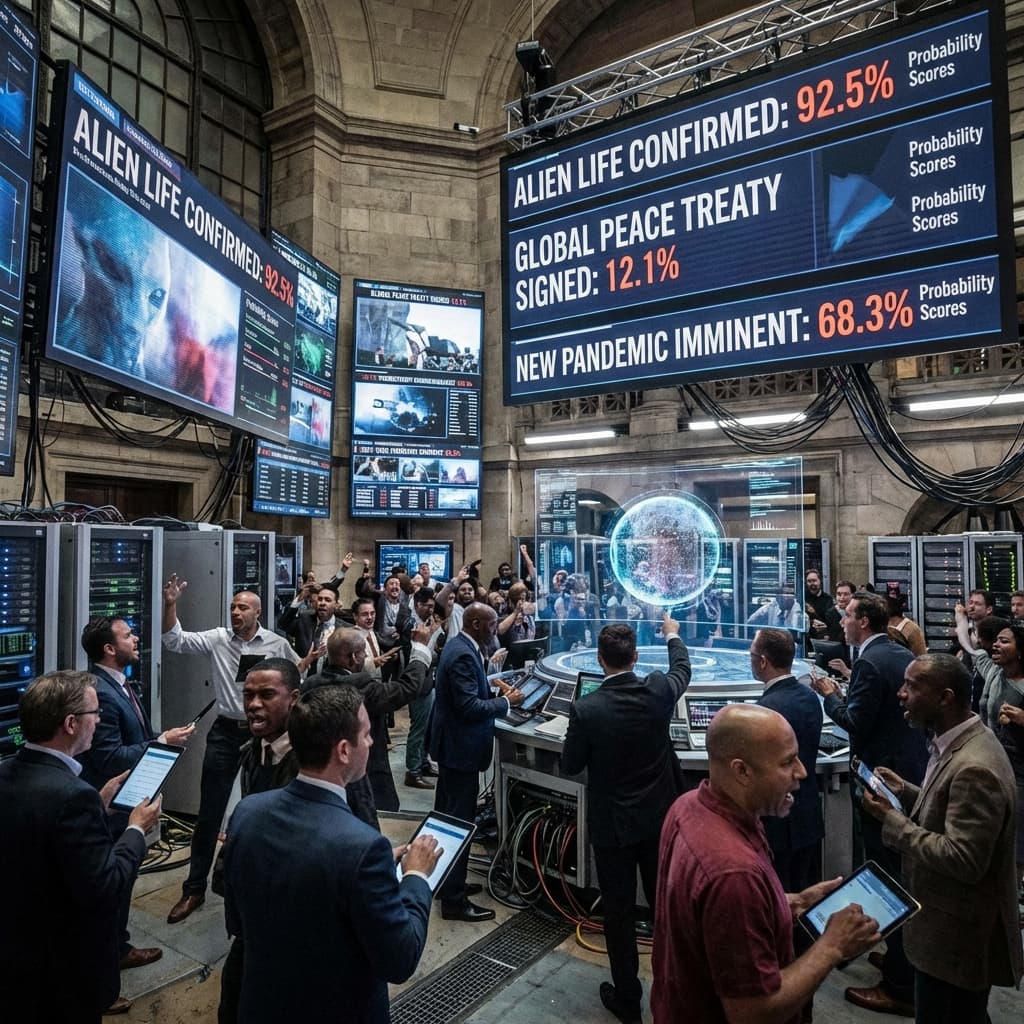
When the Associated Press reports "Candidate X is leading," it is a poll. When Polymarket (now running on its own dedicated app-chain) says "Candidate X has a 62% chance," it represents $500 million of real capital betting on that outcome. In the information wars of 2026, capital is the only filter for noise.
Beyond Politics: The 2026 Use Cases
While elections put them on the map, prediction markets now run the economy.
1. Corporate "Fire Alarms"
Tech giants use internal prediction markets. Instead of asking managers "Will the project launch on time?" (who might lie to save face), they open a market. Employees bet anonymously. If the "No" shares trade at 90 cents, the CEO knows the project is doomed, weeks before the official report.
2. Crypto Project Governance (Futarchy)
DAOs have moved to Futarchy. Instead of voting on "Do we hire Agency X?", they vote on a metric: "Prediction Market: Will token price be higher in 6 months if we hire Agency X?" The market decides the action based on the predicted economic outcome.
3. Hedging Real Risk
A farmer in Argentina doesn't just "bet" on rainfall. They buy "No Rain" shares on a weather market. If it rains, their crops grow. If it doesn't, their payout from the prediction market covers the loss. It is permissionless insurance.
The "Oracle" Problem Solved
The biggest challenge was always: Who decides who won? In 2026, UMA Protocol and decentralized dispute mechanisms have matured. If a market is disputed, token holders vote. If they vote wrongly (against reality), the honest minority forks the protocol, making the corrupt token worthless. This game-theoretic balance has proven robust enough to settle billions in volume without a centralized referee.
Regulation: The "Event Contract" War
The CFTC (Commodity Futures Trading Commission) fought hard against these markets in the US. However, the 2025 Court Ruling (Kalshi vs. CFTC) set a precedent: Event contracts are legal financial instruments if they serve a hedging purpose. This led to a bifurcation:
- Regulated Markets (Kalshi/Coinbase): KYC required, limited bet sizes, bank connected.
- DeFi Markets (Polymarket/Azuro): Permissionless, infinite liquidity, settling in USDC/USDT.
FAQ
Q: Is this just gambling? A: Technically, yes. But financially, it's information discovery. The "gamblers" provide the liquidity that creates the accurate price signal for the rest of the world.
Q: Can Elon Musk manipulate the market by betting big? A: He can try. But if he bets "Yes" when the reality is "No," he is essentially offering free money to thousands of arbitrageurs who will bet "No" until the price corrects. Deep liquidity makes manipulation expensive and temporary.
Q: How do I read the odds? A: Price = Probability. If "Yes" costs $0.60, the market assigns a 60% probability. If the event happens, the share pays out $1.00.
Q: What is "Futarchy"? A: "Vote on values, bet on beliefs." A governance form where we define the goal (e.g., higher token price) and the market decides the method to achieve it.
Q: Can I bet on sports? A: Yes, Azuro and other protocols have brought on-chain sports betting to huge volumes. But the "Prediction Market" narrative usually focuses on news/finance/science.
Conclusion
On-Chain Prediction Markets act as a "Truth Machine" in a world of Deepfakes and AI-generated news. By attaching a financial cost to being wrong, they strip away bias and wishful thinking. In 2026, checking the betting odds is as efficient as checking the weather forecast.

Related Articles
Stablecoins: The New Global Settlement Rails
SWIFT is too slow. Visa is too expensive. In 2026, Stablecoins settle $50 Trillion annually, becoming the default layer for cross-border B2B payments.
BNPL 2.0: The B2B Credit Revolution
Buy Now Pay Later isn't just for sneakers anymore. In 2026, B2B BNPL allows companies to finance cloud costs, inventory, and SaaS subscriptions on-chain.
Tokenized Mortgages 2026: Home Ownership on the Blockchain
The 30-day closing period is history. Tokenized mortgages allow for instant settlement, fractional ownership, and global liquidity for real estate debt.