


Sentiment Analysis vs. Technical Analysis 2026: The Battle for Alpha

Executive Summary: The age-old debate between fundamental and technical analysis has a new contender in 2026: AI-Driven Sentiment Analysis. Traditional chart patterns are increasingly seen as "lagging indicators" in a market moved by 24/7 social dynamics. This report analyzes why institutional capital is shifting from Moving Averages to Natural Language Processing (NLP) models that predict price action before it appears on the chart.
1. Introduction: The Death of the Lagging Indicator
For decades, traders relied on the ethos that "price discounts everything." If a breakout happened, it was visible on the chart. But in the hyper-accelerated markets of 2026, by the time a "Golden Cross" forms, the move is often already over.

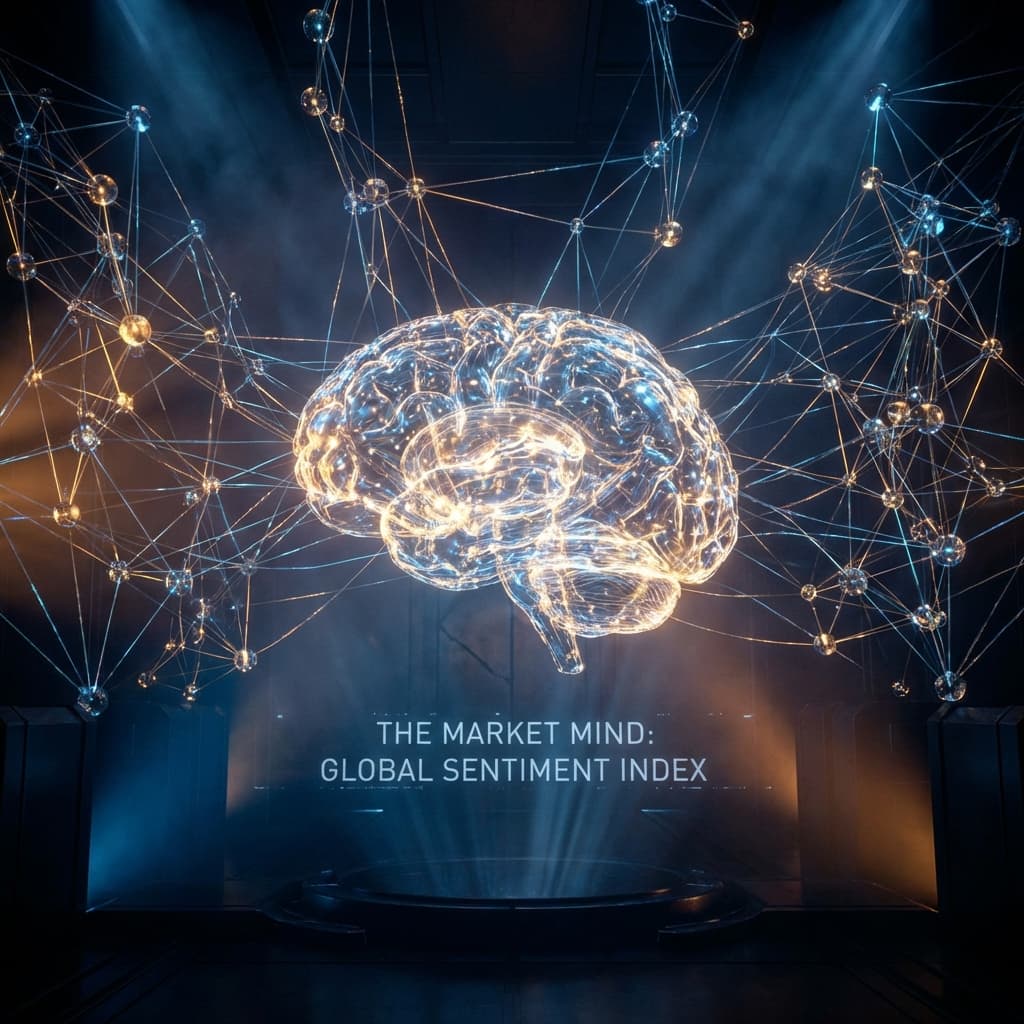
We have entered the era of Informational Velocity. Markets are no longer moved solely by earnings reports or central bank announcements, but by the perception of these events rippling through the digital consciousness of global networks. Sentiment Analysis—the algorithmic extraction of emotional tone from millions of data points—is no longer an "alternative" data source; it is the primary signal.
2. Core Analysis: Reading the Global Mood
2.1 The limitation of Technical Analysis (TA)
Technical Analysis is inherently reactive. A 50-day Moving Average (MA) is a mathematical summary of the past. In 2026, High-Frequency Trading (HFT) firms use "hunters" to identify retail traders congregating around obvious support levels, effectively weaponizing traditional TA against the crowd.

2.2 The Predictive Power of Sentiment (SA)
Sentiment Analysis is predictive. By analyzing the velocity and valence (positive/negative intensity) of language on platforms like X (formerly Twitter), Reddit, and specialized DeFi governance forums, AI models can detect a shift in conviction hours or days before it translates into buy/sell pressure.
2.3 Comparative Analysis: 2024 vs. 2026 Approaches
| Methodology | Technical Analysis (Traditional) | Sentiment Analysis (2026 AI) |
|---|---|---|
| Input Data | Price, Volume, Time | Text, Emojis, Search Volume, Memes |
| Time Orientation | Past (Lagging) | Future (Predictive) |
| Signal Source | Chart Patterns (Head & Shoulders) | NLP Topics ("Fed Pivot", "FUD") |
| Latency | Signals form after price moves | Signals form before price moves |
| Institutional Usage | Execution Timing (Algorithmic) | Alpha Generation (Strategy) |
| False Positives | High (Whipsaws in sideways markets) | Low (Context-aware filtering) |
3. Technical Implementation: The NLP Stack
For the developer or quant analyst, accessing Sentiment Alpha requires a shift in tooling.
3.1 From Pandas to Transformers
While pandas is still used for time-series data, the heavy lifting is now done by Transformer models (like BERT-Financial or FinGPT).
- Hugging Face Transformers: The standard library for loading pre-trained financial sentiment models.
- NLTK & SpaCy: Used for "Entity Recognition" (NER)—identifying which coin is being discussed (e.g., distinguishing "ETH" the token from "ETH" the suffix).
3.2 Real-Time Aggregation Architecture
A typical 2026 Sentiment Pipeline looks like this:
- Ingestion: Firehose APIs from Social Media and News Aggregators.
- Sanitization: Removing bot spam (a critical step, as 40% of 2026 traffic is agentic).
- Scoring: Assigning a floating-point score (-1.0 to +1.0) to every entity mentioned.
- Correlation: Mapping sentiment spikes to volatility probability.
# Conceptual Sentiment Scorer
def calculate_sentiment_alpha(news_stream):
    alpha_signals = []
    for article in news_stream:
        # 2026: FinBERT model for precise financial nuance
        score = sentiment_model.predict(article.headline)

        # Filter for "High Conviction" events
        if abs(score) > 0.8:
            alpha_signals.append({
                'asset': article.entity,
                'signal': 'LONG' if score > 0 else 'SHORT',
                'confidence': score
            })
    return alpha_signals
4. Challenges & Risks: The "Echo Chamber" Effect
Sentiment Analysis is not without risk.
- Agentic Feedback Loops: As AI agents generate more content, there is a risk of models training on AI-generated sentiment, creating a feedback loop or "hallucination bubble."
- Sarcasm & Nuance: Despite advances, models still struggle with the layered irony typical of "Crypto Twitter," sometimes flagging a bullish meme as bearish due to keywords like "dead" (e.g., "bears are dead").
5. Future Outlook: The Hybrid Model
The most successful fund managers in late 2026 are not abandoning charts; they are superimposing sentiment heatmaps onto their candlesticks.
We predict that by 2027, every major trading platform will offer "Sentiment Indicators" standard alongside RSI and MACD. At TradingMaster AI, we are pioneering this hybrid approach with our "News Sentiment Aggregator," allowing you to see not just where the price is, but how the market feels about it.
6. FAQ: Mastering Sentiment
1. Can sentiment analysis predict a "Flash Crash"? Often, yes. Sentiment models detect "Fear Spikes" in social discourse minutes before a massive sell-off begins, acting as an early warning system.
2. Which is better for crypto: Technical or Sentiment analysis? Crypto is an "Attention Economy" asset class. Sentiment is arguably more effective for crypto than for stocks, as crypto moves on narrative and community belief.
3. How do I access sentiment data? TradingMaster AI provides a built-in "Sentiment Score" for every asset, aggregated from global news and social sources.
4. Does sentiment work on low-cap coins? It is most effective on mid-to-high cap coins. Low-cap coins often lack enough data volume to generate a statistically significant sentiment score.
5. What is "Social Volume" vs. "Social Sentiment"? Volume is how much people are talking (hype). Sentiment is what they are saying (positive/negative). High volume + Negative sentiment is a strong Sell signal.

Related Articles
Stablecoins: The New Global Settlement Rails
SWIFT is too slow. Visa is too expensive. In 2026, Stablecoins settle $50 Trillion annually, becoming the default layer for cross-border B2B payments.
BNPL 2.0: The B2B Credit Revolution
Buy Now Pay Later isn't just for sneakers anymore. In 2026, B2B BNPL allows companies to finance cloud costs, inventory, and SaaS subscriptions on-chain.
Tokenized Mortgages 2026: Home Ownership on the Blockchain
The 30-day closing period is history. Tokenized mortgages allow for instant settlement, fractional ownership, and global liquidity for real estate debt.