
Agentic AI Trading Bots 2026: The Rise of Autonomous Finance
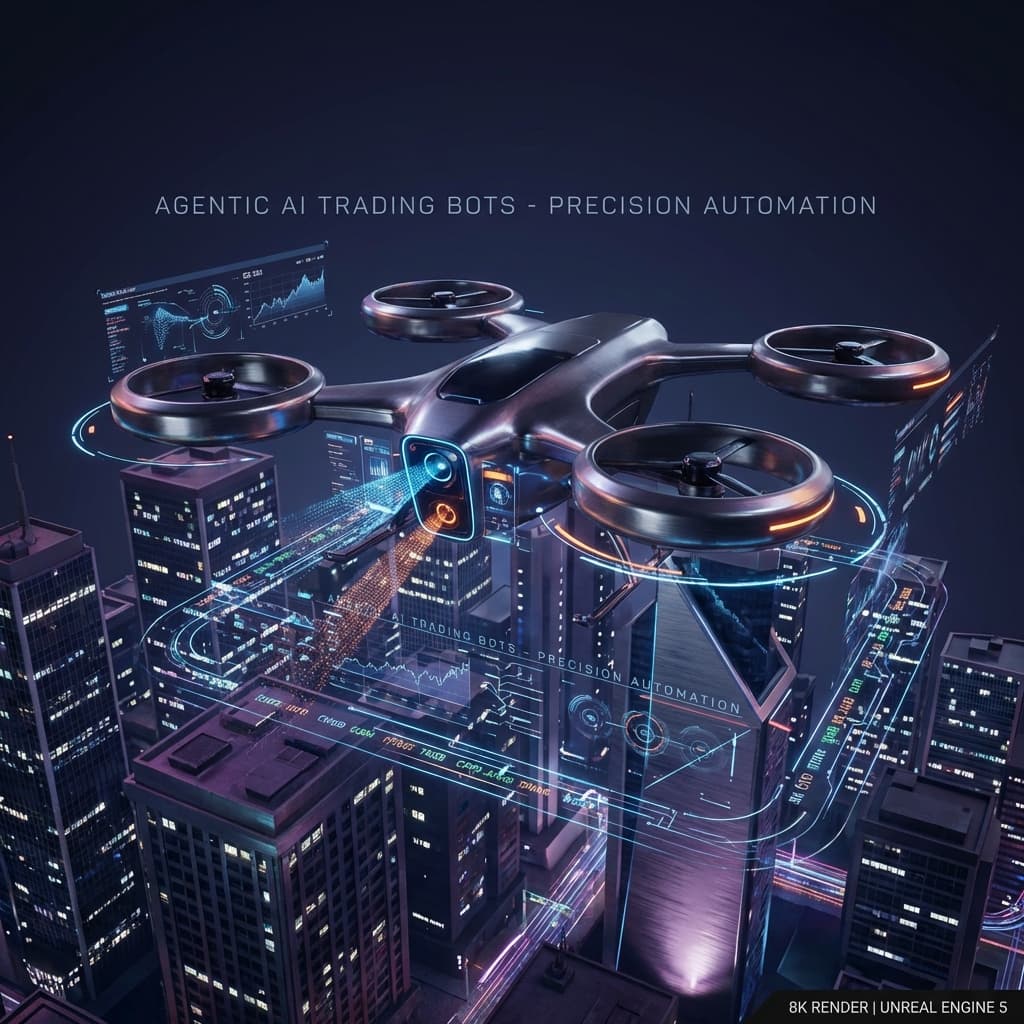
Executive Summary: The financial technology landscape entering 2026 is characterized by a fundamental restructuring driven by Agentic Artificial Intelligence (AI). Unlike the passive "chatbots" of 2024, today's AI agents are autonomous economic actors capable of executing complex financial workflows, managing risk, and navigating regulatory frameworks without human intervention. This shift marks the end of the "experimentation" era and the beginning of "operational reality" in algorithmic trading.
1. Introduction: The Agentic Shift
The era of manual trading execution is effectively over. Entering 2026, the dominant force in global capital markets is no longer the high-frequency trading (HFT) algorithm defined by static logic, but the Autonomous AI Agent.
While Generative AI (GenAI) revolutionized content creation in 2024, Agentic AI creates action. Gartner forecasts that 40% of enterprise financial applications now feature embedded AI agents, up from less than 5% just two years ago. For crypto traders and institutional investors, this distinction is critical: GenAI could tell you what the market might do; Agentic AI acts on that information, managing liquidity, executing multi-leg strategies, and auditing its own compliance in real-time.
We are witnessing the emergence of the "Agentic Economy"—a digital ecosystem where autonomous software agents perform labor, manage assets, and execute transactions on-chain, often negotiating with other agents to find the best price execution or yield opportunities.
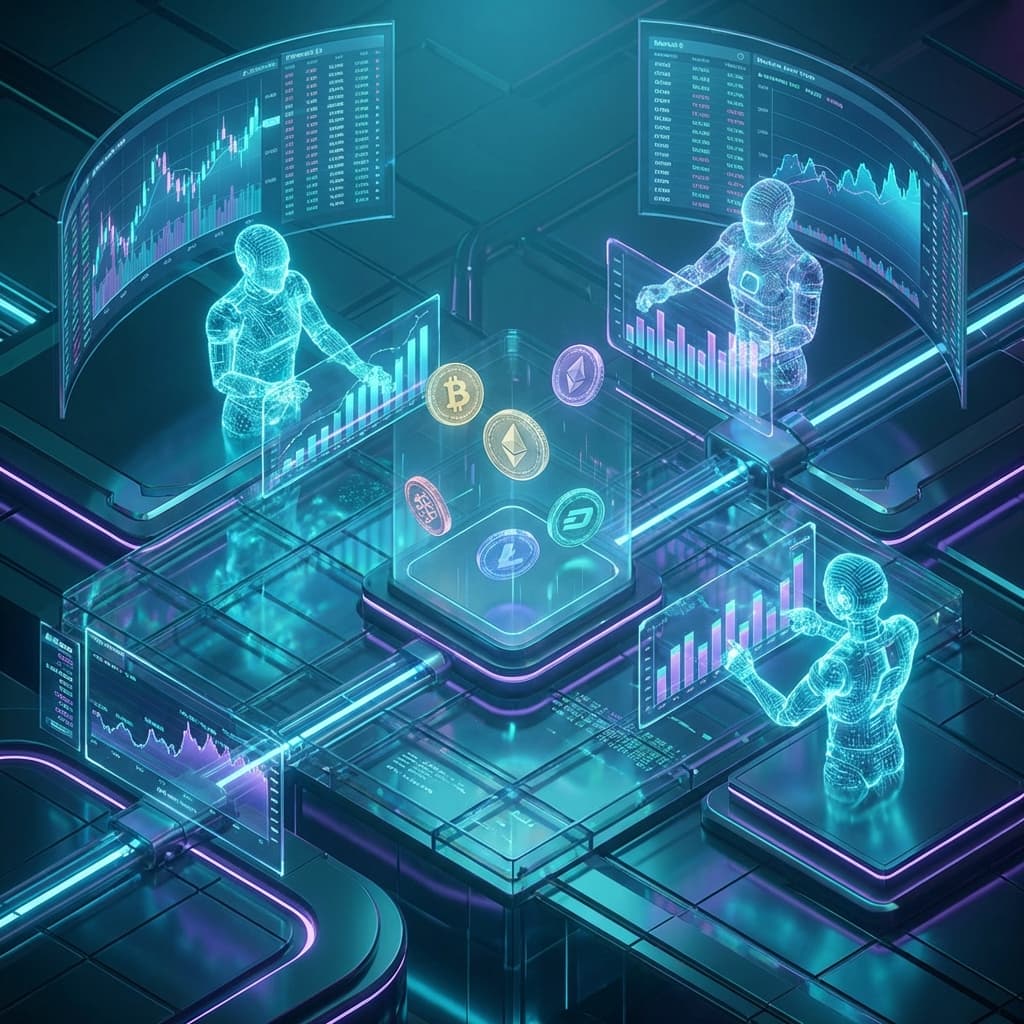
2. Core Analysis: From "Tools" to "Digital Employees"
2.1 The Liability Gap and XAI
As AI agents gain autonomy to approve loans or execute trades, the question of liability becomes paramount. If an AI agent executes a losing trade due to a "hallucination," who is responsible?
This has driven a massive demand for Explainable AI (XAI). Modern 2026 trading bots are not black boxes; they are architected with "Agentic Compliance" layers. These systems provide a real-time, immutable audit trail of why a decision was made—whether it was based on a sudden spike in on-chain sentiment, a move in the 10-year Treasury yield, or a liquidity crunch in a specific DeFi pool.
2.2 Operational Integration
Banks and Hedge Funds are deploying agents not just for execution, but for "submission triage" in underwriting and risk modeling. In the crypto sector, this manifests as bots that proactively manage Tax-Loss Harvesting and Portfolio Rebalancing without requiring constant human oversight. The role of the human trader has shifted from "pilot" to "air traffic controller"—managing a fleet of agents rather than flying the plane.
2.3 Traditional vs. Agentic Models
The specific advancements in 2026 technology versus the previous generation are stark:
| Feature | Traditional Algo Bots (2024) | Agentic AI Bots (2026) |
|---|---|---|
| Decision Logic | Rule-Based (If X, then Y) | Probabilistic & Autonomous (Reinforcement Learning) |
| Data Processing | Technical Indicators (RSI, MACD) | Multi-Modal (Sentiment, Macro, On-Chain, Reg) |
| Execution | Static Execution (TWAP/VWAP) | Adaptive "Sniper" Execution (MEV-Aware) |
| Adaptability | Requires Manual Code Updates | Self-Optimizing (Continual Learning) |
| Risk Management | Hard Stop-Losses | Dynamic Hedging & "Explainable" Risk Scoring |
| Regulation | Post-Trade Compliance Checks | Pre-Trade "Policy-as-Code" (MiCA/GENIUS) |

3. Technical Implementation: The 2026 Stack
Building an Agentic Trading Bot in 2026 requires a sophisticated stack that moves beyond basic Python scripts.
3.1 Python Ecosystem Updates
Python remains the lingua franca, but the libraries have evolved to handle event-driven architectures and massive datasets:
- Backtrader & Zipline: Still foundational for backtesting, but now integrated with vector-based engines for high-performance strategy validation.
- Vectorbt: The standard for simulating "Agentic" strategies across thousands of parameter combinations in seconds.
- LangChain for Finance: Middleware that allows LLMs to interact with financial APIs (CCXT) and execute trades based on natural language reasoning.
3.2 Agentic Architecture
A true Agentic Bot is composed of specialized sub-agents:
- The Analyst: Scans news (NLP), sentiment, and macro data.
- The Risk Manager: Enforces strict position sizing and "Policy-as-Code" compliance.
- The Executor: Interacts with the DEX/CEX, optimizing for MEV and slippage.
# Conceptual 2026 Agent Structure
class TradeExecutorAgent:
    def __init__(self, risk_manager, analyst):
        self.risk = risk_manager
        self.analyst = analyst

    async def execute_strategy(self, asset):
        sentiment_score = await self.analyst.get_sentiment(asset)
        risk_approved = self.risk.check_compliance(asset, sentiment_score)

        if risk_approved:
            # 2026: MEV-protected execution
            return await self.submit_flashbots_bundle(asset)
4. Challenges & Risks: The Regulatory Frontier
The autonomy of these agents has drawn the attention of global regulators.
- EU MiCA Regulation: Requires algorithmic trading providers to maintain detailed logs and "Kill Switches" for autonomous agents.
- US GENIUS Act: The new stablecoin and digital asset framework mandates that any "Agentic Financial Advisor" must adhere to fiduciary standards encoded directly into its operating logic.
The "Liability Gap" mentioned earlier is now a legal reality. Developers must deploy "Human-in-the-Loop" systems where critical threshold breaches require manual sign-off, ensuring that an agent cannot drain a fund due to a Black Swan event.
5. Future Outlook: The Agentic Economy
We are moving towards a world of Machine-to-Machine (M2M) Commerce. In late 2026, we expect to see the first "DAO-managed Hedge Funds" where the entire investment committee is composed of specialized AI agents, voting on asset allocation based on real-time data ingestion.
For the retail trader, the barrier to entry has never been lower, but the barrier to profitability has shifted. Success now depends on "AI Literacy"—the ability to configure, audit, and manage these powerful digital employees.
At TradingMaster AI, our "Sentiment Alpha" engine is the first step into this new world, providing the raw fuel—accurate, noise-free data—that your agents need to thrive in the 2026 market.
6. FAQ: Understanding Agentic Trading
1. What is the difference between a grid bot and an Agentic AI bot? A grid bot follows a fixed grid of buy/sell orders regardless of market conditions. An Agentic AI bot perceives the market context (e.g., "The Fed just raised rates") and can decide to pause trading, hedge its position, or switch strategies entirely without human intervention.
2. Is Agentic AI legal in the US and EU? Yes, but under strict compliance frameworks like MiCA (EU) and the GENIUS Act (US). Agents must have audit trails and risk controls ("Kill Switches").
3. Do I need to know Python to use Agentic AI? Not necessarily. Platforms like TradingMaster AI provide "No-Code" interfaces where you define the goals (e.g., "Preserve capital, target 10% APY") and the agents handle the execution.
4. How does Agentic AI handle market crashes? Unlike rigid algorithms that keep buying the dip until liquidation, Agentic AI uses predictive risk modeling to identify "Volatile Regimes" and can exit positions or hedge with derivatives before the crash bottoms out.
5. Can Agentic AI effectively trade meme coins? Yes, specifically by using NLP (Natural Language Processing) to value "Attention Economy" assets. Agents can track social sentiment velocity on X (Twitter) and Reddit faster than any human, capturing the "Sentiment Alpha" before price action follows.

Related Articles
AI Sentiment Analysis: Decoding Crypto Twitter 2026
Charts lie. Twitter doesn't. Learn how AI bots scrape millions of tweets to detect FOMO and FUD before the candles move.
Neuromorphic Computing: The Future of Trading Bots 2026
GPUs are power hungry. Neuromorphic chips (like Intel Loihi 3) mimic the human brain, allowing trading bots to run with 1000x less energy.
Reinforcement Learning Trading Strategies 2026
Traditional bots follow rules. AI bots learn from mistakes. Discover how Deep Reinforcement Learning (DRL) agents are beating the market.