

Stablecoin Depeg Risk Models 2026: Detecting the Warning Signs

Executive Summary: History is littered with "Stablecoins" that weren't (UST, USDD). Even giants like USDC depegged in 2023. In 2026, relying on "Trust Me Bro" audits is insufficient. This report outlines the mathematical models used by institutional desks to predict a depeg event hours before it happens.
1. Introduction: The $1.00 Illusion
A stablecoin is only worth $1.00 if the market believes it is. When confidence erodes, the peg breaks. For a Risk Manager, the goal is not to predict if a stablecoin will survive, but to exit at $0.99 before it hits $0.80.
2. Core Analysis: Leading Indicators
Institutional risk models track three specific metrics to flag a depeg risk.
2.1 The Curve 3Pool Imbalance
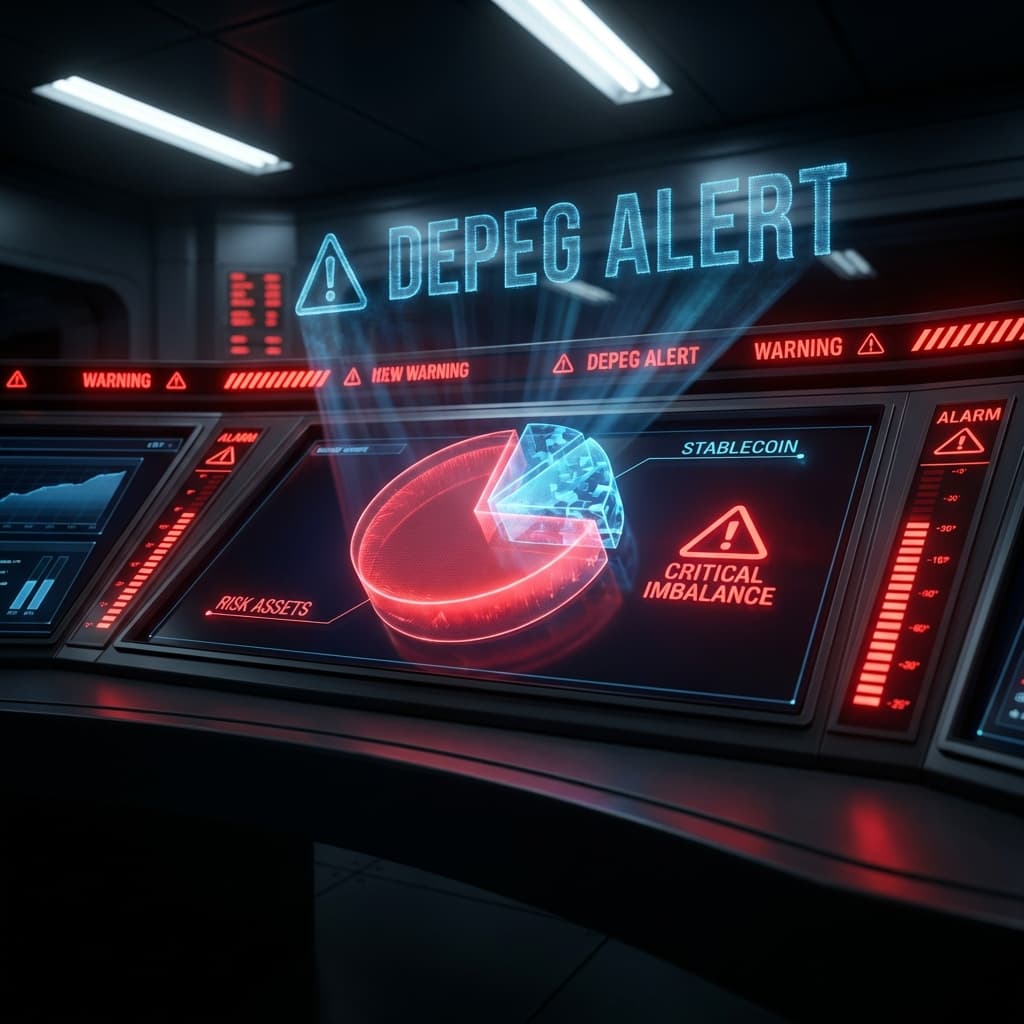
The Curve 3Pool (USDT/USDC/DAI) is the deepest liquidity source for stables.
- Healthy State: 33% / 33% / 33% balance.
- Warning Sign: If one asset becomes >60% of the pool, everyone is dumping it. This happened 24 hours before the UST crash.
2.2 Treasury Yield Inversion
If 3-Month US Treasuries yield 5%, but a stablecoin issuer (like Circle) holds 10-Year Bonds yielding 3%, they have a "Duration Mismatch." If everyone redeems at once, the issuer becomes insolvent. In 2026, on-chain "Proof of Reserve" feeds track this mismatch in real-time.
2.3 Stablecoin Safety Ratings 2026
| Stablecoin | Backing Mechanism | Depeg Risk | Liquidity Depth |
|---|---|---|---|
| USDC | Fiat + Short Term T-Bills | Very Low | High |
| USDT | Fiat + "Commercial Paper" | Medium | Extreme |
| DAI (USDS) | Overcollateralized Crypto | Low | High |
| Ethena (USDe) | Delta Neutral Hedge | High (Basis Risk) | Medium |
| Algo-Stable | Governance Token | Extreme (Death Spiral) | Low |

3. Technical Implementation: The Depeg Watcher
Automated systems monitor the exchange rate on Uniswap and Curve.
# 2026 Depeg Monitor
def check_peg_health(stablecoin):
    price = get_oracle_price(stablecoin)

    # Thresholds
    if price < 0.995:
        level = "YELLOW ALERT"
    elif price < 0.980:
        level = "RED ALERT (EXIT NOW)"
    else:
        level = "GREEN"

    # Check Curve Balance
    pool_share = get_curve_balance(stablecoin)
    if pool_share > 0.65:
        level = "RED ALERT (LIQUIDITY DUMP)"

    return level
4. Challenges & Risks: False Positives
Sometimes, a depeg is just noise (e.g., a large whale selling for unrelated reasons).
- The Difference: A true depeg is accompanied by Outflows. If the price drops but Total Value Locked (TVL) remains high, it's an arbitrage opportunity. If TVL drops with price, run.
5. Future Outlook: The CBDC Killer
As Central Bank Digital Currencies (CBDCs) launch in late 2026, private stablecoins face an existential threat. Why hold USDC (private debt) when you can hold FedCoin (public liability)? Answer: Privacy. The market will demand private stablecoins for transactions they want to keep "off the Fed's radar."
6. FAQ: Stablecoin Safety
1. Is USDT safe in 2026? Tether has survived every stress test. However, its lack of a full audit remains a "Black Swan" risk.
2. What is "Basis Risk"? For Delta-Neutral stables (like Ethena), basis risk occurs if the funding rate turns negative, meaning the protocol loses money to keep the hedge open.
3. Should I diversify stablecoins? Yes. A basket of 33% USDC, 33% USDT, and 33% DAI reduces the risk of any single failure wiping you out.
4. What happens if USDC fails? Given its integration with BlackRock, a USDC failure would likely trigger a government bailout or "backstop" to prevent systemic financial collapse.
5. How to profit from a depeg? Short the depegging asset on a perp exchange (like dYdX) or borrow it on Aave and sell it for a safe asset.

Related Articles
Crypto Trading Addiction: The Silent Crisis of 2026
When the charts control your life, you've already lost. Recognizing the signs of dopamine-driven trading addiction and actionable strategies to reclaim your mental health.
AI-Powered Explainable Risk Management: Beyond VaR
The Black Box era is over. In 2026, Institutional Risk Management demands Explainable AI (XAI) to detect tail risks invisible to traditional VaR models.
DeFi Insurance Protocols 2026: Protecting Your Yield
Don't yield farm naked. In 2026, DeFi insurance is no longer optional. We review Nexus Mutual v4, Unslashed, and the rise of Parametric Covers.