

MEV Protection Strategies: Avoiding the Dark Forest

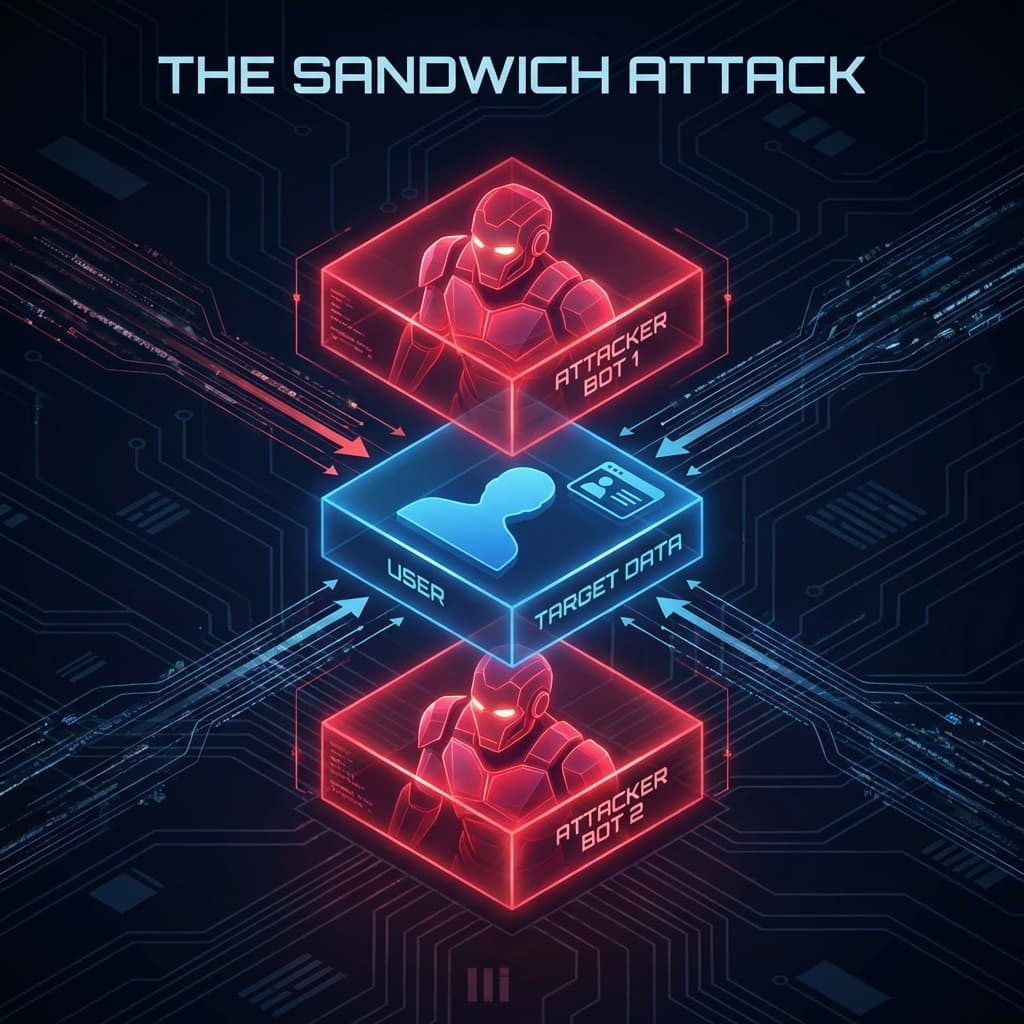
Executive Summary: Ethereum's mempool is a "Dark Forest" where predators wait. If you broadcast a large buy order publicly, Maximal Extractable Value (MEV) bots will front-run you, push the price up, and back-run you for a risk-free profit. This guide covers the essential defense mechanisms for 2026.
1. Introduction: The Invisible Tax
You place a trade for 10 ETH. The slippage tolerance is set to 1%. It executes at exactly -0.99%. Bad luck? No. You were "Sandwiched." An MEV bot saw your transaction in the mempool, paid a higher gas fee to buy before you, and sold immediately after you pushed the price up. This tax costs traders billions annually.
2. Core Analysis: The Defense Stack
2.1 Private Transactions (OFA)
The only way to win is not to play in public. Order Flow Auctions (OFA) allow you to send your transaction directly to a Block Builder, bypassing the public mempool entirely.
- Flashbots Protect: The industry standard RPC.
- MEV-Blocker: Offers "rebates" (kicks back 90% of the sandwich profit to you).
2.2 Intent-Based Trading
Instead of submitting a transaction ("Buy X on Uniswap"), you submit an Intent ("I want X for price Y"). Solvers compete to fill your order off-chain. If they can't fill it at your price, nothing hits the chain.
2.3 Mempool vs. Private RPC Comparison
| Feature | Public Mempool (Default) | Private RPC (Flashbots) |
|---|---|---|
| Visibility | Everyone (Bots watching) | Only the Builder |
| Sandwich Risk | High | Zero |
| Execution Speed | Fast | Slower (Wait for block inclusion) |
| Cost | Gas Only | Gas + Tip (Optional) |
| Failures | Failed Txs cost Gas | Failed Txs don't land on-chain |

3. Technical Implementation: Configuring the RPC
For Algo Traders using web3.py or ethers.js, switching to a private mempool is a one-line change.
# 2026 Web3 Setup for MEV Protection
from web3 import Web3
from flashbots import flashbot

# Connect to Flashbots Protect RPC instead of Infura
w3 = Web3(Web3.HTTPProvider("https://rpc.flashbots.net"))

# Sign transaction locally
tx = {
    'to': UNI_ROUTER,
    'value': w3.to_wei(1, 'ether'),
    'gas': 200000,
    'gasPrice': 0, # Flashbots uses direct payments
    'nonce': nonce,
    'chainId': 1
}
signed_tx = w3.eth.account.sign_transaction(tx, private_key)

# Send via Private Bundle
print("Sending private transaction...")
w3.eth.send_raw_transaction(signed_tx.rawTransaction)
4. Challenges & Risks: Builder Centralization
If 90% of order flow goes through one builder (e.g., BeaverBuild), they control the network. In 2026, Ethereum has implemented Proposer-Builder Separation (PBS) at the protocol level to mitigate this, enforcing a wall between who builds the block and who proposes it.
5. Future Outlook: Encrypted Mempools
By 2027, we expect Encrypted Mempools (using Threshold Cryptography) to become native. This means validators can order transactions without knowing their content until after the block is finalized, mathematically eliminating front-running.
6. FAQ: MEV
1. Does Layer 2 (Arbitrum/Base) have MEV? Yes. Whenever there is a sequencer, there is potential for MEV, though it is often captured by the sequencer itself rather than third-party bots.
2. Is MEV illegal? It is a gray area. "Sandwiching" is considered market manipulation in traditional finance, but "Arbitrage" (aligning prices) is healthy. The EU MiCA regulation is beginning to distinguish between "Toxic MEV" and "Healthy MEV."
3. Does using Flashbots cost money? No. In fact, it saves money because you don't pay for failed transactions.
4. How do I know if I was sandwiched? Tools like EigenPhi allow you to paste your Transaction Hash and see if a bot profited from your trade.
5. Can AI bots sandwich me? Yes. AI agents are now the primary operators of MEV strategies, optimizing gas bids dynamically to extract maximum value.

Related Articles
CosmWasm & IBC: The Future of Interchain Trading
Solidity is for local apps. Rust (CosmWasm) is for Interchain apps. Discover how IBC allows you to trade across 50+ blockchains instantly.
Decentralized Orderbook Architectures: The CLOB Evolution
AMMs were just the beginning. In 2026, the Central Limit Order Book (CLOB) has finally moved on-chain. We analyze Hyperliquid, dYdX v5, and the end of Impermanent Loss.
HFT Latency Arbitrage Techniques 2026: The Race to Zero
In the world of 2026 HFT, microseconds are eternities. Explore how FPGA hardware and quantum-resistant networks are redefining latency arbitrage.